


Brass Gravity Die Casting – Precision Permanent Mould Brass Castings from India
Price: US$ 11.50 / Kilogram
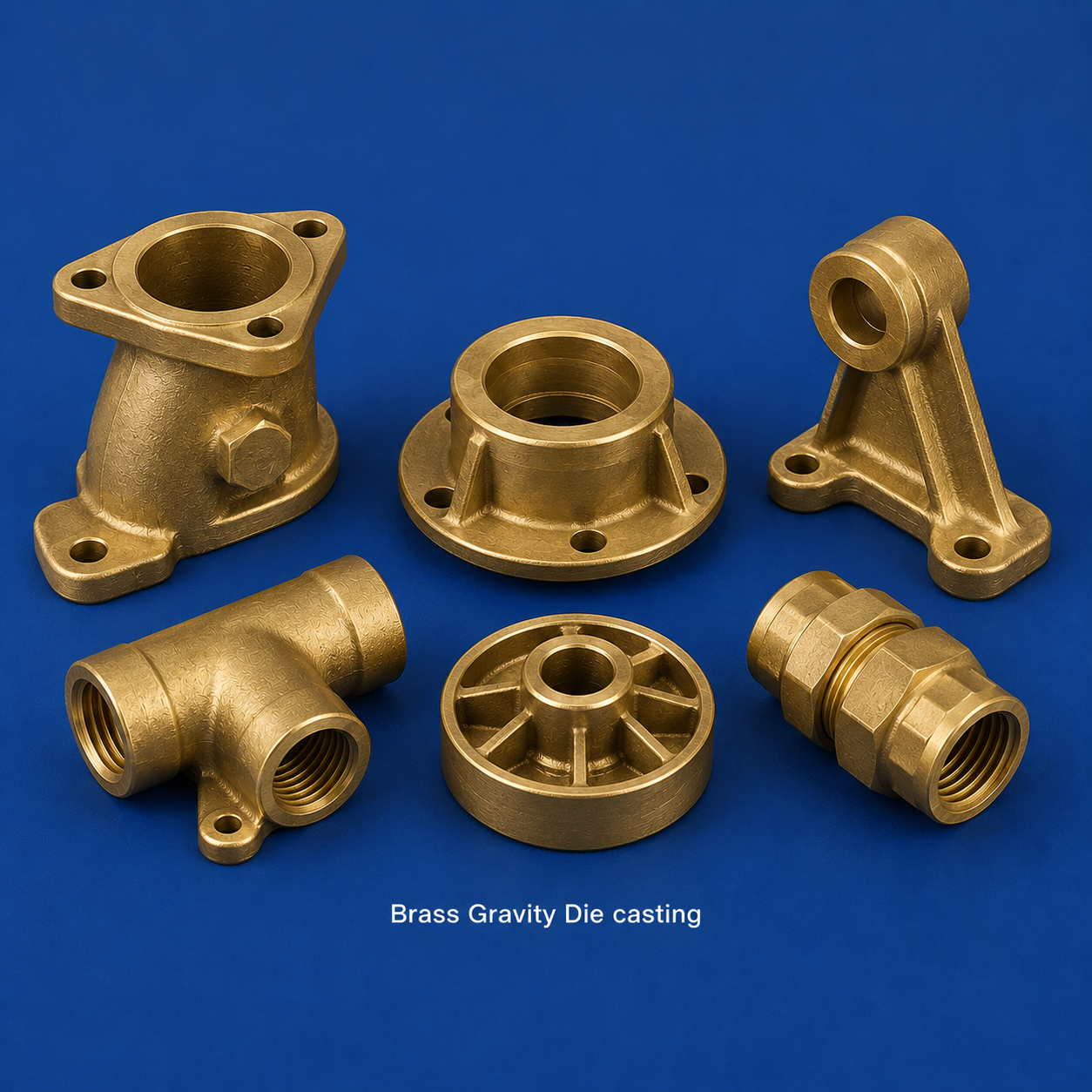
Brass gravity die casting is a precision metal forming process in which molten brass alloy is poured under gravity into a permanent steel or cast iron mould, producing dimensionally accurate, dense, and mechanically sound components. Conex Casting, a leading manufacturer and exporter based in Mumbai, India, supplies brass gravity die castings to electrical OEMs, EPC contractors, power utilities, valve manufacturers, plumbing hardware producers, and industrial distributors across North America, Europe, the Middle East, and Southeast Asia. The process eliminates the porosity associated with sand casting and delivers tighter tolerances, superior surface finish, and repeatable metallurgical quality suited to high-volume B2B procurement.
Product Overview
What is Brass Gravity Die Casting?
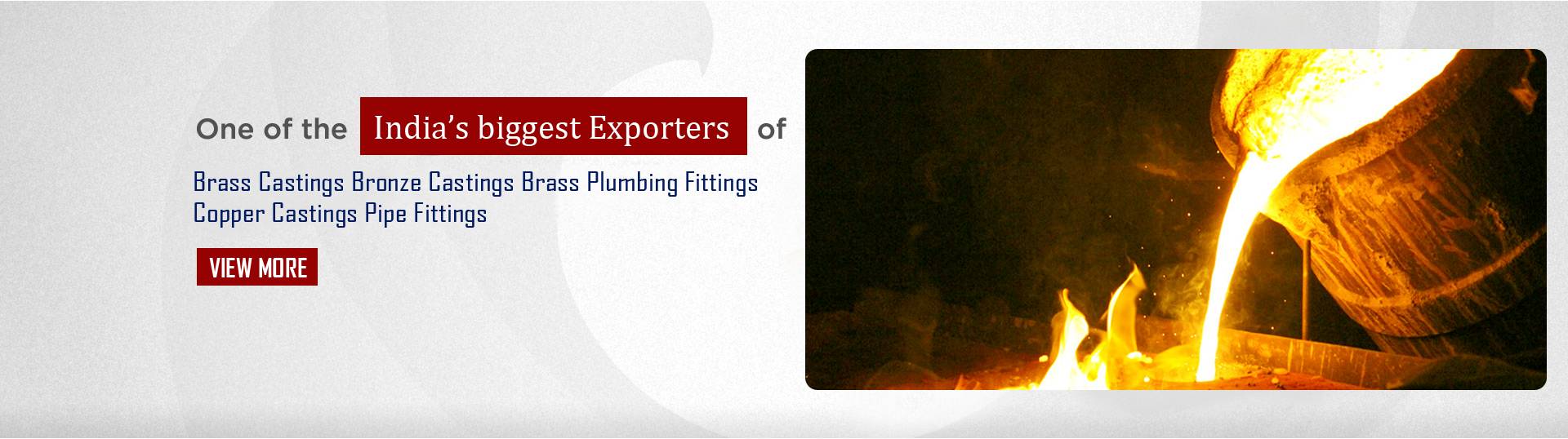
Gravity die casting – also termed permanent mould casting, tilt-pour casting, or low-pressure die casting – uses reusable metal moulds and the force of gravity alone to fill the die cavity with molten brass. The mould is coated with a refractory wash, preheated to 150–300 °C, and filled by tilting or straight pouring. Cycle times are shorter than sand casting, and the permanent mould promotes rapid, directional solidification that refines the grain structure and enhances mechanical properties such as tensile strength, hardness, and corrosion resistance – attributes critical for connectors, terminals, valve bodies, and structural electrical hardware.
Brass Alloy Families Used in Gravity Die Casting
Brass is a binary or multi-component copper–zinc alloy with variable amounts of lead, tin, aluminium, and manganese to enhance machinability, corrosion resistance, strength, and castability. Common alloy families include alpha brass (Cu 70–85%), alpha-beta or duplex brass (Cu 55–65%), and leaded free-cutting brass. Each family offers distinct castability windows, solidification ranges, and service characteristics. Our metallurgical team selects the optimal alloy based on end-use environment, pressure rating, conductivity requirements, and post-cast machining demands from clients in the electrical, plumbing, marine, and automotive sectors.
Dimensional Capability and Tolerances
Gravity die cast brass components can be produced in weights ranging from 50 g to 25 kg per casting. Dimensional tolerances of ±0.3 mm to ±0.8 mm are achievable without post-machining, tightening to ±0.05 mm after CNC finishing. Surface roughness values of Ra 3.2–6.3 µm are standard as-cast, suitable for sealing surfaces, threads, and mating flanges. Wall thicknesses as low as 2.5 mm can be maintained consistently across production runs, making the process ideal for compact electrical enclosures, earthing clamps, cable gland bodies, and bus-bar connectors.
Thermal and Electrical Properties
Brass exhibits electrical conductivity of 15–28% IACS (International Annealed Copper Standard), thermal conductivity of 100–120 W/m·K, and a melting range of 900–940 °C for common gravity die casting alloys. These properties make brass gravity die castings indispensable in electrical switchgear components, instrument housings, earthing hardware, and current-carrying connectors where a combination of moderate conductivity, machinability, and corrosion resistance is required. Dezincification-resistant (DZR) brass grades provide extended service life in aggressive water and humid electrical environments.
Surface Finishing and Secondary Operations
Post-cast operations available include CNC turning, milling, and drilling; thread tapping (BSP, NPT, metric); nickel plating, tin plating, chrome plating, or yellow passivation; powder coating and e-coating for outdoor electrical applications; pressure testing up to 60 bar for valve and fitting castings; and ultrasonic or radiographic inspection for critical structural components. These capabilities allow Conex Casting to deliver fully finished, assembly-ready brass parts that meet OEM dimensional and surface quality specifications without additional vendor involvement.
Corrosion Resistance and Environmental Compatibility
Brass alloys offer inherent resistance to atmospheric corrosion, fresh water, steam, and many industrial chemicals. Dezincification-resistant grades (CW602N, CW625N) meet BS EN 12165 and ISO 6509 dezincification tests, making them compliant with European potable water regulations (WRAS, DVGW, ACS). Lead-free brass grades conforming to REACH and RoHS requirements are available for drinking water fittings and environmentally sensitive electrical equipment, providing compliance pathways for EU, US, and Australian markets.
Comparison with Other Casting Processes
Compared to sand casting, gravity die casting produces better surface finish, tighter dimensional tolerances, and superior mechanical properties due to faster solidification. Compared to high-pressure die casting (HPDC), gravity die casting handles higher alloy lead contents, accommodates thicker sections, and avoids the entrapped gas porosity inherent to high injection pressures – making it preferable for pressure-tight valve bodies and fittings. Compared to lost-wax investment casting, gravity die casting offers lower tooling costs and faster cycle times for medium-to-high production volumes, typically from 500 to 500,000 pieces per year.
Material Grades – Brass Alloys for Gravity Die Casting
IS 319 – Indian Standard Leaded Brass (Free-Cutting Brass)
IS 319 Type I (Cu 60–63%, Pb 2.5–3.5%, Zn remainder) is the most widely specified brass casting alloy in Indian manufacturing. Its high lead content provides outstanding machinability (rated at 100% relative to free-cutting brass standards), excellent pressure tightness, and good casting fluidity. Used for valve bodies, tap bodies, compression fittings, electrical cable glands, and plumbing fittings. Equivalent to CW617N (EN), C36000 (ASTM/UNS), CuZn39Pb3 (ISO), and MS 58 (trade name).
IS 319 Type II – Medium Leaded Brass
IS 319 Type II (Cu 57–60%, Pb 1.5–2.5%, Zn remainder) offers slightly lower machinability but improved corrosion resistance over Type I. It is specified where both machining and moderate corrosion resistance are required in a single alloy, such as for hydraulic manifold bodies, gas meter components, and multi-port valve housings in industrial pipework systems.
CW617N / CuZn39Pb3 – EN European Free-Cutting Brass
CW617N is the European standard equivalent of IS 319 Type I and ASTM C36000. Composition: Cu 57–59%, Pb 2.5–3.5%, Zn 37.5–40%. This grade meets EN 12164, EN 12165, and EN 12167. It is the standard alloy for European electrical conduit fittings, lockable valves, metering components, and compression connectors. CW617N complies with the Drinking Water Directive (DWD 98/83/EC) with appropriate surface treatment for low-lead-extract applications.
CW602N / CuZn36Pb2As – Dezincification-Resistant (DZR) Brass
CW602N contains arsenic (0.02–0.15%) as an inhibitor that prevents dezincification in aggressive water conditions. This grade is mandatory under BS 2525 and EN 12165 for potable water fittings in the UK (WRAS approval) and Germany (DVGW approval). Applications include hot and cold water valves, compression fittings for gas and water, sprinkler system components, and irrigation fittings. The DZR test per ISO 6509 confirms dezincification resistance with penetration depth below 200 µm.
C85700 / C87600 – ASTM Silicon Brass and Semi-Red Brass
ASTM C85700 (Cu 59–63%, Sn 0.5–1.5%, Zn remainder) and C87600 (Cu 90–94%, Si 3.5–5.5%) are North American standard casting alloys for plumbing hardware, valve bodies, and marine hardware. C87600 silicon brass offers superior corrosion resistance, lead-free compliance (California Prop 65, NSF 372), and excellent pressure tightness, making it the preferred alloy for potable water components in the US market.
CuZn33 / CW506L – Low-Zinc Admiralty-Type Brass
CuZn33 (Cu 67%, Zn 33%) is an alpha-phase brass with better corrosion resistance than duplex alloys, particularly in marine and humid environments. It is used for electrical connector housings, instrument bezels, hydraulic coupling nuts, and decorative hardware where high ductility and cold formability post-casting are required. The low zinc content reduces the risk of stress corrosion cracking (SCC) in ammonia-containing environments common in refrigeration and chemical plants.
C46400 – Naval Brass (Tobin Bronze)
Naval brass (Cu 59–62%, Sn 0.5–1.0%, Zn remainder) was developed for marine seawater service. Its tin addition provides superior resistance to dezincification and biofouling. Cast naval brass components are used in marine fittings, offshore electrical junction boxes, seawater pump housings, and shipboard valve bodies where resistance to salt water corrosion over extended service periods is the primary design criterion.
CuZn37 / CW508L – Standard Cartridge Brass
CW508L (Cu 63%, Zn 37%) is a high-ductility alpha brass used where post-cast forming, deep drawing, or crimping operations are required. Applications include electrical terminal housings, crimp connectors, butt-joint connectors, and fuse holders where the casting provides the body shape and subsequent press operations produce the contact features. The alloy has good electrical conductivity (~27% IACS) and is easily tin-plated or silver-plated for electrical contact enhancement.
Key Features of Brass Gravity Die Castings
- Price: US$ 11.50 per kilogram (ex-works Mumbai, India)
- Weight range: 50 g to 25 kg per casting
- Dimensional tolerance: ±0.3 mm (as-cast), ±0.05 mm (after CNC machining)
- Surface roughness: Ra 3.2–6.3 µm as-cast
- Minimum wall thickness: 2.5 mm
- Production quantity: 500 to 500,000 pieces/year
- Available with full CNC machining, threading, and surface plating
- ISO 9001:2015 certified manufacturing facility
- Lead-free and DZR grades available for regulatory compliance
- 100% dimensional inspection with CMM report on request
Superior Mechanical Properties
Brass gravity die castings exhibit tensile strength of 280–420 MPa, yield strength of 100–200 MPa, and elongation of 15–35% depending on alloy grade and heat treatment. Hardness values range from 60–120 HB. The rapid directional solidification in the permanent mould refines the beta-phase distribution in duplex brasses, improving ductility and reducing the risk of hot tearing. These properties are verified by destructive testing on batch samples per EN 1982, IS 318, or ASTM B584 depending on the client’s specification standard.
Consistent Dimensional Accuracy
The reusable steel mould ensures dimensional repeatability across production runs measured in thousands of shots. Mould life typically exceeds 30,000 cycles for brass, far surpassing sand mould single-use economics. CAD/CAM-designed moulds incorporate controlled shrinkage allowances (1.3–1.6% for brass), draft angles, and core prints to produce net-shape or near-net-shape castings that require minimal machining stock. Matched mould halves are aligned with guide pins to eliminate flash and maintain parting-line dimensional control to ±0.2 mm.
High Productivity and Process Repeatability
Automated tilt-pour and ladle-pour gravity casting machines achieve cycle times of 60–180 seconds per casting, enabling high-volume production without the capital cost of high-pressure die casting equipment. Robotic extraction and automated shot-blasting further reduce cycle time and improve surface consistency. Statistical process control (SPC) is applied to key dimensional parameters, with Cpk ≥ 1.33 maintained for critical dimensions on long-running production programmes.
Comprehensive Alloy Range
Conex Casting maintains alloy inventory conforming to IS 319, IS 318, EN 1982, EN 12165, ASTM B584, ASTM B455, SAE J461, and JIS H5120. Multi-element spectrometric analysis (OES – Optical Emission Spectrometry) is performed on every heat to confirm chemistry before casting. Mill test certificates (MTC) and material test reports (MTR) are issued per EN 10204 3.1 or 2.2 as required by the client’s quality plan.
Regulatory and Compliance Readiness
Available certifications and compliance documents include RoHS Declaration of Conformity, REACH SVHC compliance statement, NSF 61 / NSF 372 potable water compliance (lead-free grades), WRAS approval (DZR grades), DVGW approval, California Proposition 65 compliance, and CE marking support documentation for pressure equipment (PED 2014/68/EU). These are provided as part of the standard quality documentation package for export shipments to EU, US, UK, GCC, and Australian markets.
Flexible Production and MOQ
Minimum order quantities start at 500 pieces for repeat orders on existing tooling, with no minimum for tooling development orders. Conex Casting offers vendor-managed inventory (VMI), Kanban call-off scheduling, and bonded warehouse programs for high-volume OEM clients. Standard lead times are 4–6 weeks for new tooling and 2–3 weeks for repeat production runs. Expedited 10-day production is available for urgent requirements with pre-qualified tooling.
Technical Specifications
| Parameter | Specification |
|---|---|
| Base Material | Copper-Zinc Alloy (Brass) |
| Casting Process | Gravity Die Casting / Permanent Mould Casting |
| Weight Range | 50 g – 25 kg per casting |
| Dimensional Tolerance (as-cast) | ±0.3 mm – ±0.8 mm |
| Dimensional Tolerance (machined) | ±0.05 mm – ±0.1 mm |
| Surface Roughness (as-cast) | Ra 3.2 – 6.3 µm |
| Minimum Wall Thickness | 2.5 mm |
| Pouring Temperature | 950 – 1050 °C |
| Mould Preheat Temperature | 150 – 300 °C |
| Shrinkage Allowance | 1.3 – 1.6% |
| Tensile Strength | 280 – 420 MPa |
| Yield Strength | 100 – 200 MPa |
| Elongation | 15 – 35% |
| Hardness | 60 – 120 HB |
| Electrical Conductivity | 15 – 28% IACS |
| Thermal Conductivity | 100 – 120 W/m·K |
| Density | 8.4 – 8.7 g/cm³ |
| Mould Life | 25,000 – 50,000 shots |
| Production Volume | 500 – 500,000 pieces/year |
| Unit Price | US$ 11.50 / kg |
Brass Alloy Grade and International Equivalent Table
| Indian Standard (IS) | European (EN / CW) | ASTM / UNS (USA) | ISO | JIS (Japan) | Key Characteristic |
|---|---|---|---|---|---|
| IS 319 Type I | CW617N / EN 12164 | C36000 / UNS C36000 | CuZn39Pb3 | C3604 | Free-cutting, high machinability |
| IS 319 Type II | CW616N | C35300 | CuZn36Pb1.5 | C3601 | Medium leaded, corrosion resistant |
| IS 318 | CW614N | C38500 | CuZn38Pb2 | C3771 | High-strength brass casting |
| – | CW602N / EN 12165 | C35330 | CuZn36Pb2As | – | DZR, dezincification resistant |
| – | CW625N | – | CuZn21Si3P | – | Silicon brass, lead-free, DZR |
| – | CW508L | C27000 | CuZn37 | C2700 | Cartridge brass, high ductility |
| – | CW506L | C26000 | CuZn33 | C2600 | Alpha brass, marine/humid use |
| – | – | C46400 | CuZn38SnPb | C4622 | Naval brass, seawater resistant |
| – | – | C85700 | – | – | Semi-red brass casting, ASTM B584 |
| – | – | C87600 | CuSi5 | – | Silicon brass, NSF 61 potable water |
Product Types and Variants
Conex Casting supplies brass gravity die castings in the following product categories. All items are available with full secondary machining, threading, and surface finishing:
- Valve Bodies and Bonnets – Ball valve bodies, gate valve bonnets, globe valve bodies, check valve bodies, pressure relief valve housings (DN15 to DN150)
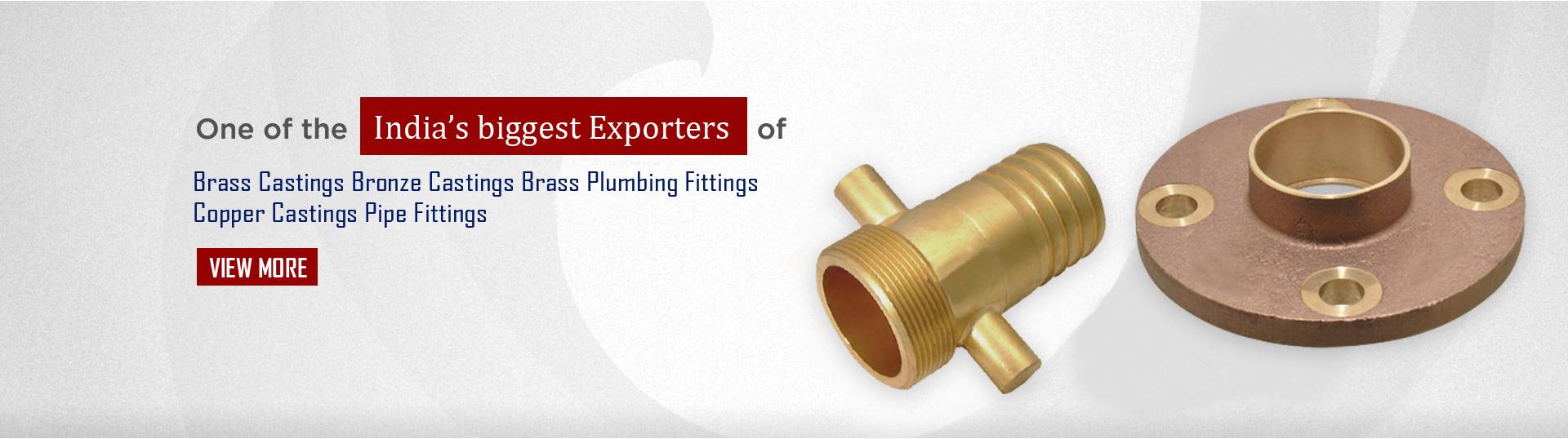
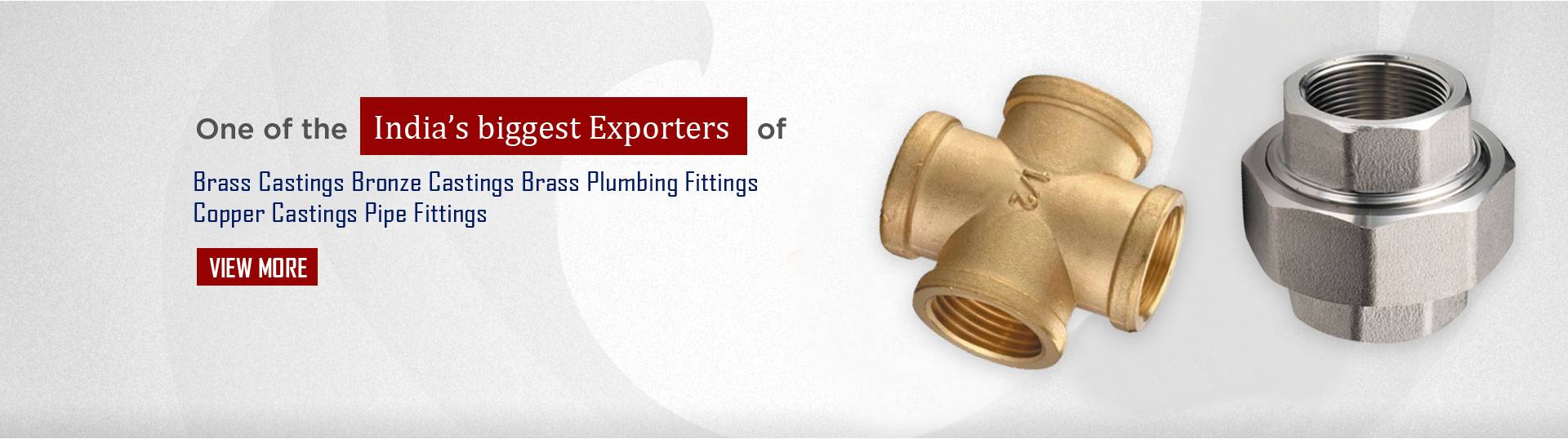
- Plumbing and Pipeline Fittings – Compression elbows, tees, couplings, reducers, end caps, union nuts, olive fittings (BSP, NPT, metric)
- Electrical Hardware – Cable gland bodies, earthing terminals, switchgear brackets, connector housings, butt-joint connectors, bus-bar end caps
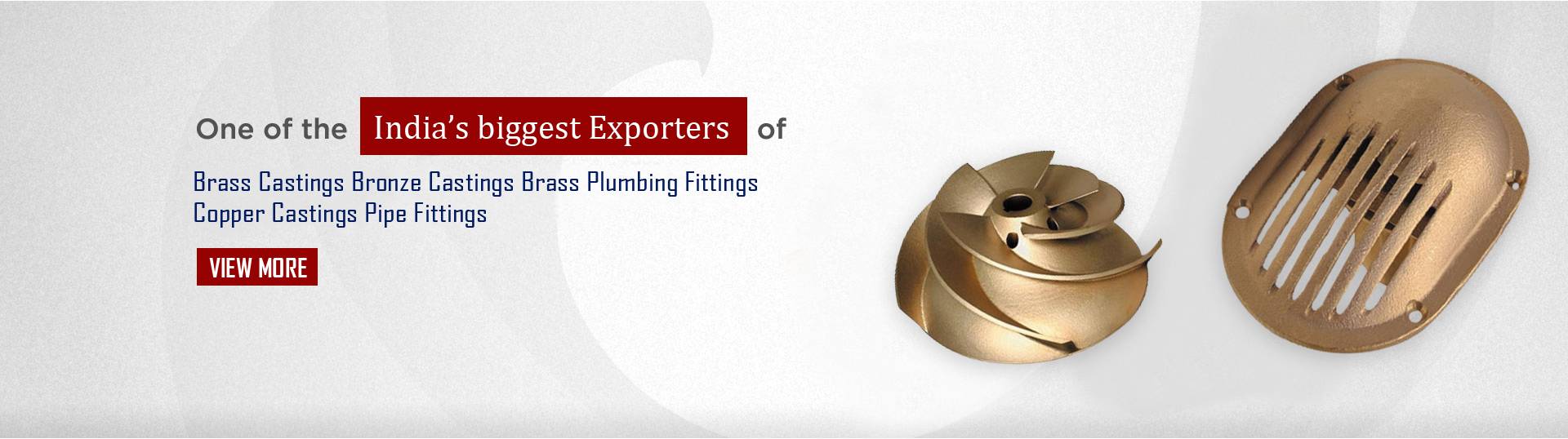
- Pump and Fluid Handling Components – Impellers, pump casings, bearing housings, seal carriers, metering valve bodies
- Architectural and Decorative – Door handles, lock bodies, hinges, tap bodies, mixer valve bodies, bathroom accessories
- Instrumentation – Pressure gauge sockets, flow meter bodies, thermowell housings, instrument manifolds
- Automotive and Industrial – Hydraulic manifolds, pneumatic valve bodies, coupling nuts, bracket castings
Applications by Industry
| Industry Sector | Typical Brass Gravity Die Cast Components |
|---|---|
| Electrical & Power Utilities | Cable gland bodies, earthing clamps, switchgear housings, bus-bar end fittings, neutral link bodies, LV connector housings |
| EPC Contractors | Conduit fittings, junction box covers, valve trim, instrumentation brackets, earthing terminals |
| Plumbing & HVAC | Compression fittings, ball valve bodies, radiator valves, thermostatic mixing valves, pump impellers |
| Oil & Gas | Instrument manifolds, gauge valve bodies, sour service valve components, flow meter housings |
| Marine | Sea-cock valve bodies, through-hull fittings, pump casings, deck hardware, shipboard electrical housings |
| Water Treatment | Backflow preventer bodies, strainer housings, sampling valve bodies, metering pump components |
| Automotive / Off-Highway | Hydraulic manifolds, pneumatic valves, coupling bodies, sensor housings |
| Building Services | Sprinkler heads, gas valve bodies, fire hydrant components, irrigation valve bodies |
Typical Parts Produced — Brass Gravity Die Casting
Brass gravity die casting is well suited to complex, medium-volume components requiring close dimensional tolerances, leak-free integrity, and excellent machinability. The table below lists the most commonly produced part families, their indicative dimensions, and the industries they serve.
| Part / Component | Common Alloy Grade | Indicative Size / Weight | Key Industry |
|---|---|---|---|
| Valve Bodies (ball, gate, globe, check) | IS 319 Type I, CW617N | DN15–DN100 | 0.2–4.5 kg | Plumbing, HVAC, Oil & Gas, Building Services |
| Compression Fitting Bodies (straight, elbow, tee) | CW617N, CuZn37 | DN8–DN54 | 0.05–0.6 kg | Plumbing, Water Distribution, Gas Supply |
| Cable Gland Bodies (metric, PG, NPT) | IS 319 Type II, CW602N DZR | M16–M63 | 0.04–0.35 kg | Electrical, Power Utilities, EPC Contractors |
| Pump Impellers | CW617N, C85700 | Ø50–Ø200 mm | 0.15–2.0 kg | HVAC, Water Treatment, Building Services |
| Earthing Clamps & Terminals | IS 319 Type I, CuZn37 | 10–120 mm² conductor | 0.02–0.2 kg | Electrical Utilities, Switchgear OEMs |
| Switchgear Housings & Connector Bodies | IS 319 Type II, CW617N | 50×50–200×150 mm | 0.1–1.5 kg | Electrical OEMs, Panel Builders |
| Conduit Fittings (adaptors, locknuts, reducers) | IS 319 Type I | M16–M63 | 0.02–0.15 kg | EPC Contractors, Industrial Wiring |
| Thermostat & Radiator Valve Bodies | CW617N, CuZn33 | DN10–DN25 | 0.08–0.5 kg | HVAC, District Heating, Building Services |
| Gas Meter Components & Regulator Housings | CW617N, C46400 Naval Brass | DN15–DN50 | 0.2–2.0 kg | Gas Distribution, Utilities |
| Hydraulic Manifold Blocks | CW617N, IS 319 Type I | 50–200 mm cube | 0.3–5.0 kg | Automotive, Off-Highway, Industrial |
| Instrument Valve Bodies & Manifolds | CW617N, C85700 | DN6–DN25 | 0.05–0.8 kg | Oil & Gas, Process Industry |
| Fire Sprinkler Heads & Hydrant Parts | C46400, CW617N | DN15–DN25 | 0.05–0.4 kg | Fire Protection, Building Services |
| Bus-Bar End Fittings & Neutral Link Bodies | IS 319 Type I, CuZn37 | 40–150 mm length | 0.05–0.6 kg | LV Switchgear, Power Distribution OEMs |
| Flow Meter Housings | CW617N, C87600 | DN15–DN80 | 0.3–3.5 kg | Water Utilities, Process Industry |
| Sea-Cock & Through-Hull Fittings | C46400 Naval Brass, CuZn33 | DN20–DN80 | 0.4–3.0 kg | Marine, Shipbuilding |
| Decorative Hardware (handles, knobs, brackets) | CuZn37, CuZn33 | 20–200 mm | 0.02–0.8 kg | Architecture, Sanitary Fittings, OEM Hardware |
Parts Produced by Industry Sector — Quick Reference
| Industry | Representative Parts | Required Properties |
|---|---|---|
| Electrical & Power Utilities | Cable gland bodies, earthing clamps, neutral link bodies, switchgear housings, bus-bar end caps, LV connector housings, instrument transformer brackets | High conductivity, corrosion resistance, thread integrity, UL/IEC compliance |
| EPC Contractors & Panels | Conduit adaptors, junction box covers, locknut fittings, cable entry plates, conduit bends, earthing terminals, panel mounting brackets | IP65+ rating, precise thread tolerances, RoHS compliance |
| Plumbing & Water Supply | Compression tees, elbows, straight couplings, push-fit bodies, isolating valve bodies, service valve bodies, meter connectors | Dezincification resistance (DZR), WRAS approval, pressure rating ≥ 16 bar |
| HVAC & Building Services | Radiator valve bodies, thermostatic mixing valve housings, pressure reducing valve bodies, balancing valve bodies, pump impellers, pipe couplings | High pressure/temperature rating, low lead content, corrosion resistance to treated water |
| Oil, Gas & Petrochemical | Instrument manifold bodies, gauge valve bodies, needle valve bodies, sour service components, non-sparking fittings, instrument cable glands | H2S resistance (NACE MR0175), non-sparking, torque retention under thermal cycling |
| Marine & Offshore | Seacock valve bodies, through-hull fittings, deck hardware, saltwater pump casings, shipboard lighting housings | Seawater corrosion resistance, anti-biofouling, DNV/Lloyd’s compliance |
| Automotive & Off-Highway | Hydraulic manifolds, pneumatic valve bodies, quick-connect couplings, sensor housings, gear pump bodies | Pressure integrity to 250 bar, vibration resistance, oil/fuel compatibility |
| Water Treatment & Utilities | Backflow preventer bodies, strainer housings, check valve discs, metering pump components, sampling valve bodies | Chlorine resistance, low lead (<4% Pb), hygienic approvals |
Manufacturing Process
The brass gravity die casting process at Conex Casting follows a structured sequence: (1) Mould Design and Manufacture – 3D CAD modelling, FEA-based solidification simulation (Magmasoft / ProCAST), and CNC machining of H13 tool steel or GGG-70 spheroidal graphite iron moulds with controlled draft angles, venting systems, and cooling channels; (2) Alloy Preparation – Spectrometric OES analysis of incoming ingots and return metal to confirm chemistry to IS 319, CW617N, or client-specified grade before charging the induction furnace; (3) Mould Preparation – Application of refractory mould coat (colloidal graphite or zirconia-based wash), preheat to 150–300 °C, and installation of sand or metal cores as required; (4) Pouring – Ladle or tilt-pour into the preheated mould at a controlled temperature of 950–1050 °C, with degassing by nitrogen purging or rotary degassing to minimise hydrogen porosity; (5) Solidification and Ejection – Controlled cooling, mould opening at or below 300 °C, and ejection using extractors or manual knockout; (6) Fettling and Shot Blasting – Gate and riser removal, vibratory or shot-blast cleaning; (7) Machining and Finishing – CNC turning, milling, drilling, threading, deburring; (8) Inspection – Dimensional CMM inspection, pressure testing, spectrometric analysis, visual inspection, and NDT as required; (9) Packaging – Export packing in poly-lined wooden crates or cartons with VCI film protection for sea freight.
Quality Standards and Certifications
| Standard / Certification | Scope |
|---|---|
| ISO 9001:2015 | Quality Management System – design, manufacturing, inspection |
| IS 319 / IS 318 | Indian Standard for brass casting alloys |
| EN 1982 / EN 12165 | European standard for copper alloy castings and wrought products |
| ASTM B584 / B455 | ASTM standard for copper alloy sand and permanent mould castings |
| ISO 6509 | Dezincification resistance test for DZR brass grades |
| RoHS 2011/65/EU | Restriction of hazardous substances – available for all lead-free grades |
| REACH (EC) 1907/2006 | SVHC compliance declaration available on request |
| NSF 61 / NSF 372 | Potable water safety – available for lead-free grades (C87600, CW625N) |
| WRAS (UK) | Water Regulations Advisory Scheme – DZR grades |
| EN 10204 3.1 / 2.2 | Material test certificates with spectrometric analysis |
| PED 2014/68/EU | Pressure Equipment Directive compliance documentation |
Why Choose Conex Casting for Brass Gravity Die Castings?
- 40+ years of casting expertise – Established manufacturer with deep metallurgical knowledge of brass, bronze, and copper alloys
- In-house mould shop – CNC machined moulds in H13 tool steel, designed using solidification simulation software
- Full secondary machining capability – CNC turning, milling, drilling, threading, and assembly under one roof
- Multi-standard alloy compliance – IS, EN, ASTM, JIS, and ISO grade availability with spectrometric certificates
- Competitive pricing – US$ 11.50/kg, ex-works Mumbai; DDP pricing available for major trade lanes
- Export experience – Shipments to 40+ countries with full export documentation, LC handling, and third-party inspection support
- Quality infrastructure – CMM, OES spectrometer, pressure test bench, ultrasonic flaw detection, and hardness testing on-site
- Regulatory compliance – RoHS, REACH, NSF 372, WRAS, DVGW documentation readily available
- Responsive technical support – Application engineering, DFM review, and failure analysis provided to OEM customers
Equivalent Terms
| Language | Equivalent Terms for Brass Gravity Die Casting |
|---|---|
| Spanish | Fundición en molde permanente de latón, Colada por gravedad de latón, Fundición a presión por gravedad latón |
| French | Coulée en coquille par gravité en laiton, Moulage en coquille laiton, Fonderie laiton coquille |
| Russian | Литьё латуни в кокиль, Гравитационное литьё в постоянную форму латунь, Кокильное литьё латунных деталей |
| Portuguese | Fundição em molde permanente de latão, Fundição por gravidade em latão, Coquilha latão fundição |
| Italian | Fusione in conchiglia per gravità in ottone, Colata per gravità in ottone, Fusione in stampo permanente ottone |
Frequently Asked Questions (FAQ)
Q1. What is the minimum order quantity for brass gravity die castings?
The minimum order quantity for repeat production on existing tooling is 500 pieces. For new tooling development, there is no minimum piece count, although tooling investment is required. Tooling costs are quoted separately and typically range from USD 800 to USD 8,000 depending on component complexity and mould size.
Q2. What is the standard lead time for new brass gravity die casting orders?
New tooling fabrication and first article samples take 4–6 weeks from approved drawing. Repeat production on established tooling has a standard lead time of 2–3 weeks. Expedited 10-day production is available for pre-qualified tooling with additional scheduling charges.
Q3. Can you produce lead-free brass gravity die castings for potable water applications?
Yes. We supply lead-free brass grades including CW625N (CuZn21Si3P), C87600 (silicon brass), and CW602N (DZR arsenic-bearing brass) that comply with NSF 61, NSF 372, WRAS, and DVGW requirements for potable water contact applications. Full compliance documentation is provided.
Q4. Which international material standards do you work to?
We cast to IS 319, IS 318, EN 1982, EN 12165, ASTM B584, ASTM B455, SAE J461, and JIS H5120. If your specification references a different standard, our metallurgical team can identify the closest equivalent and confirm chemistry compliance by spectrometric analysis.
Q5. What surface finishes are available on brass gravity die castings?
Available finishes include: as-cast (shot blasted), CNC machined, electroless nickel, electrolytic nickel, tin plating, chrome plating, yellow chromate passivation, powder coating, and e-coating. Surface finish selection depends on the end-use environment, mating component requirements, and any regulatory constraints.
Q6. Can Conex Casting supply fully machined and tested brass castings?
Yes. We offer fully finished, assembly-ready brass castings including CNC turning, milling, drilling, threading, pressure testing (up to 60 bar hydraulic), and dimensional inspection with CMM report. This turnkey capability reduces vendor count and supply chain complexity for OEM customers.
Q7. How do you control alloy chemistry and casting quality?
Every heat of brass is analysed by Optical Emission Spectrometry (OES) before pouring. Dimensional inspection uses CMM with traceable calibration. Pressure-critical castings undergo hydrostatic or pneumatic leak testing. NDT methods including ultrasonic testing (UT) and dye penetrant inspection (DPI) are applied to high-integrity components. Material Test Certificates per EN 10204 3.1 are issued on request.
Q8. What is the pricing for brass gravity die castings?
The indicative price for brass gravity die castings is US$ 11.50 per kilogram, ex-works Mumbai, India. Final pricing depends on alloy grade, part complexity, machining requirements, surface finish, quantity, and delivery terms. Formal quotations are issued within 24 hours of receiving drawings and specifications.
Q9. Do you supply to electrical OEMs and EPC contractors?
Yes. Electrical OEMs, EPC contractors, and power utilities are among our primary customer segments. We supply cable gland bodies, earthing hardware, connector housings, switchgear brackets, and bus-bar components to major electrical equipment manufacturers and project contractors across India, the Middle East, Southeast Asia, and Europe.
Q10. What is the difference between gravity die casting and high-pressure die casting for brass?
Gravity die casting fills the mould using only gravitational force, producing dense, porosity-free castings suitable for pressure-tight applications such as valve bodies and fittings. High-pressure die casting (HPDC) injects metal at high velocity, which can trap gas and create porosity – making HPDC unsuitable for pressure-critical or heat-treatable brass applications. Gravity die casting is preferred for brass due to the alloy’s high lead content, which can cause die soldering in HPDC tooling.
Related Products – Gravity Die Casting Category
Request a Quote
Contact Conex Casting for a formal quotation on brass gravity die castings. Send your technical drawings (DXF, STEP, IGES, PDF), material specification, quantity requirements, and required delivery terms to sales@conex-casting.com or call +91-22 43449300/23. Quotations are issued within 24 hours. Our team provides DFM feedback, alloy selection guidance, and application engineering support at no additional charge.